![[subscription]](http://heartstrongsleep.com/cdn/shop/files/Group_30_6a2ee5b7-7d1a-49f1-855d-428a7cb5358f.png?v=1733846466&width=600)

Finding the right treatment for sleep apnea can feel like navigating a sea of alphabet soup. Between CPAP, APAP, and BiPAP, the terminology is often confusing, yet choosing the correct device is the most important step toward a restful night and better long-term health.
While all three machines use Positive Airway Pressure (PAP) to keep your airway from collapsing, they differ significantly in how they deliver that air. This guide breaks down the differences and the pros and cons of each to help you have an informed conversation with your sleep specialist.
CPAP stands for Continuous Positive Airway Pressure. It is the most common and widely studied treatment for Obstructive Sleep Apnea (OSA).
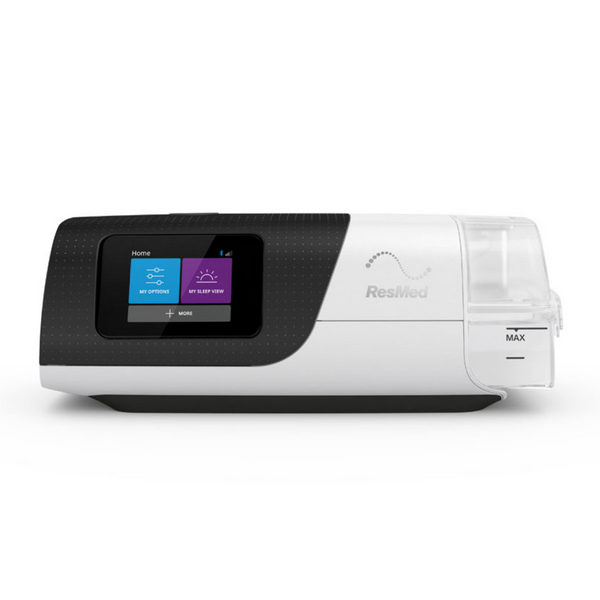
A CPAP machine delivers a single, steady stream of air at a fixed pressure setting determined by your doctor. This pressure remains exactly the same whether you are inhaling or exhaling, acting like an "air splint" to keep your throat open.
The Pros of CPAP
-
Proven Reliability: As the most studied form of therapy, its effectiveness in treating standard OSA is well-documented.
-
Affordability: CPAP machines are generally the most budget-friendly option and are standard for insurance coverage.
-
Simplicity: With only one pressure setting, there is less for the user to troubleshoot or adjust.
The Cons of CPAP
-
Exhalation Difficulty: Some users find it physically tiring to breathe out against a constant incoming flow of air.
-
Fixed Nature: If your needs change—such as if you roll onto your back or have a glass of wine—the fixed pressure might become too low to be effective or too high to be comfortable.
-
Adjustment Period: New users often feel a "suffocating" sensation because the air never stops pushing.
APAP stands for Automatic Positive Airway Pressure. Think of this as the "smart" version of a CPAP machine.
Instead of one fixed setting, an APAP machine uses an algorithm to monitor your breathing breath-by-breath. It operates within a range (e.g., 5 to 15 cm $H_{2}O$) and increases pressure only when it detects a collapse or snoring, then lowers it when your breathing stabilizes.
The Pros of APAP
-
Adaptive Comfort: It provides the minimum pressure necessary at any given moment, making it much easier to fall asleep.
-
Ideal for Variable Sleepers: It automatically adjusts for changes in sleep position, weight fluctuations, or nasal congestion from allergies.
-
At-Home Titration: Doctors often use APAPs to find a patient’s ideal pressure range without requiring an expensive, overnight lab study.
The Cons of APAP
-
Price Tag: The advanced sensors and software make APAP machines more expensive than basic CPAP models.
-
Variable Noise: Some light sleepers are disturbed by the sound of the motor ramping up and down throughout the night.
-
Algorithm Lag: In rare cases, the machine may not react fast enough to a sudden apnea event compared to a fixed-pressure device.
BiPAP (or BPAP) stands for Bilevel Positive Airway Pressure. Unlike the others, it provides two distinct pressure levels.
The machine delivers a higher pressure when you inhale (IPAP) and drops to a significantly lower pressure when you exhale (EPAP). This creates a breathing pattern that feels much more natural and less resistive.
The Pros of BiPAP
-
High-Pressure Tolerance: For patients who require very high pressure to keep their airways open, BiPAP makes that pressure bearable by "getting out of the way" during exhalation.
-
Medical Versatility: It is often the only option for patients with complex conditions like Central Sleep Apnea, COPD, or congestive heart failure.
-
Natural Feel: The dual-pressure system mimics the body’s natural respiratory rhythm more closely than a CPAP.
The Cons of BiPAP
-
High Cost: These are the most expensive machines on the market due to their complex mechanical ventilation capabilities.
-
Insurance Hurdles: Most insurance providers require proof that you "failed" CPAP or APAP therapy before they will cover a BiPAP.
-
Complexity: The settings are more technical and must be carefully managed by a medical professional to ensure the correct balance of oxygen and carbon dioxide.
The "best" machine isn't the most expensive one; it’s the one that you will actually wear every night.
Most people begin with a CPAP or APAP for standard obstructive sleep apnea. However, if you find it impossible to exhale against the air or if you have underlying lung or heart issues, a BiPAP may be the life-changing solution you need.
Questions? Please contact us : 877-815-7300